
Learning a new language can be a profound act of love. It’s a commitment of time and energy – a gesture that says: ‘I want to understand your world.’ And when the language in question is British Sign Language (BSL) it becomes a vital act of connection.
It’s crucial to understand that BSL is not a simplified version of English. Colin Brook, Media Relations Officer at The National Deaf Children’s Society (NDCS), stresses “the importance of recognising BSL as a rich language in its own right”, with its own grammar and structure, and is not to be mistaken with Makaton (which uses pictures and gestures with speech).
The need for this linguistic bridge is stark. Colin points out that while “12 million people in the UK are D/deaf, only around 151,000 people use BSL, of whom 87,000 are D/deaf”. This leaves a vibrant linguistic community isolated, making the act of learning BSL by a hearing person not just a loving gesture, but a powerful move towards inclusion.
If you learn BSL for your child, “it can help reduce feelings of isolation and frustration and encourages stronger communication with family members”, says Colin.
“True inclusion for BSL users means they can access the same range of opportunities as hearing people in their preferred language,” he adds. “Even if there is still a long way to go, the legal recognition of BSL by the BSL Act and the increased visibility of positive D/deaf roles on TV and the media helps increase public awareness of deafness and D/deaf issues.”
The best way to learn to sign is with a qualified BSL teacher. Here, BSL users share how it has changed their relationship with loved ones.
A strong friendship: Sarah and Charlie
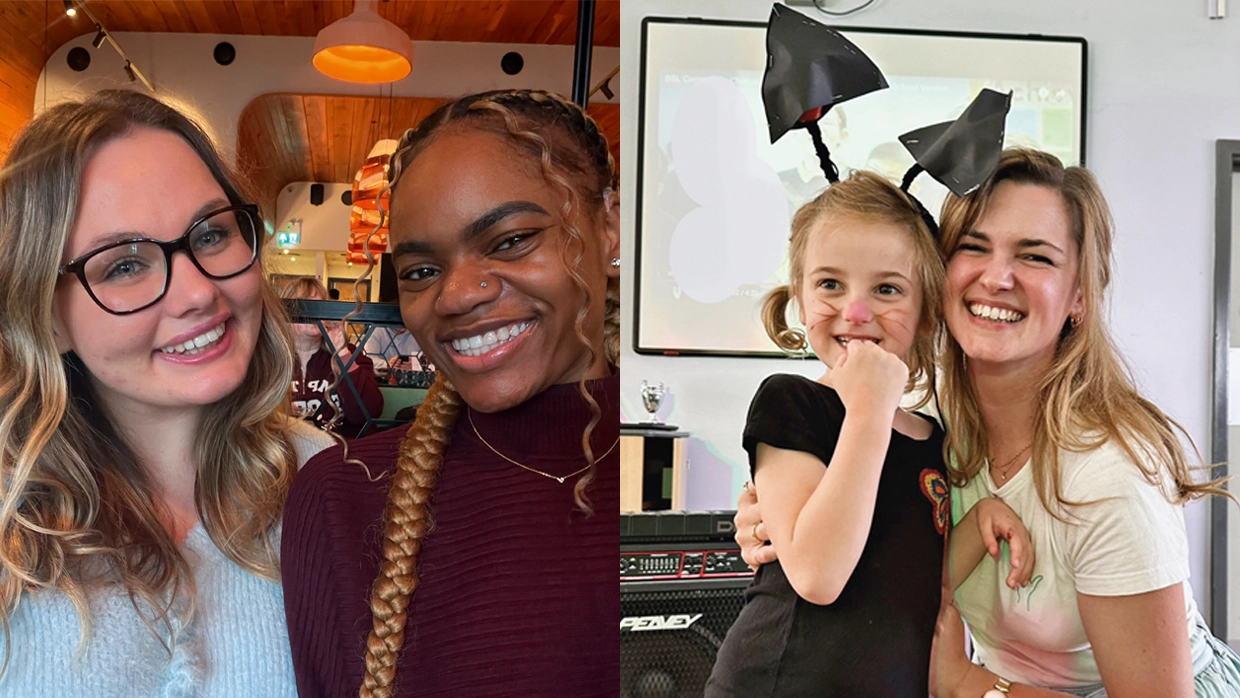
When Sarah Adedeji and Charlie John met at secondary school aged 13, BSL lessons were available, but Charlie “wasn’t very interested”. That changed when their friendship began. For Sarah, language and identity were already a complex issue. “I am profoundly Deaf,” she explains. “I was able to learn SSE (Sign Supported English) in primary school, but it was once I entered a Deaf residential school that I was properly exposed to BSL. That’s where I fell more in love with this language.
"Learning BSL empowered me in different ways: my identity, my voice, my confidence. I found my voice in my hands... I felt as if I finally belonged,” says Sarah. “I am currently an adult audiologist... even adults need to see Deaf professionals, more so those who lose their hearing later on in life. It helps to break down stigma and misconceptions, and helps with confidence and acceptance of hearing loss.”
While Sarah felt she was pulling away from her family, Charlie stepped in. “When I met Sarah, I was so inspired by her and her mindset. I knew instantly that we would be friends,” says Charlie. “She had a lot going on and so I thought that I would make her life a little easier and learn BSL so that she could relax a little and feel heard.”
This decision proved to be a turning point for Sarah. “None of my family had learnt BSL and yet this girl I happened to meet in secondary school turned round and decided she was going to make an effort because she wanted to understand me and embrace my deafness,” recalls Sarah.
“It felt amazing. It was one of the first times in life someone had taken the initiative to communicate with me based on my needs without question. It made me feel seen, understood and valued. I didn’t feel small around Charlie.”
While Charlie is now at BSL Level 2, she is open about the effort involved. “Learning BSL has definitely helped our friendship grow,” she says. “Don’t get me wrong, signing for me is hard and I really have to think about what I am doing, but I suppose that’s the same for any Deaf person with actually speaking.”
That effort has strengthened their friendship, allowing them to share moments of joy as well as helping them to navigate emergencies. Charlie has been able to support Sarah’s BSL performing work, which includes signing songs. “I had not been to any of her events before, so this was big for us. I made a big sign that said I was her number one fan,” says Charlie.
“We have also been on holidays together... on one flight home Sarah had an issue and ended up fainting, just after her implant battery had run out. I was able to sign to her and communicate what the air stewards were saying. This calmed both of us down.”
Twelve years after they met, their bond is stronger than ever. “We are able to communicate in different ways now,” reflects Charlie, who is a primary school teacher and teaches children signs during lessons, too.
“If you have a friend who is Deaf, you never know how much it means to them. It will strengthen your relationship more than you know.”
A mother and daughter's journey: Tilly and Ada
Tilly Hawkes’ journey into BSL began when her daughter, Ada, was 18 months old. Ada was born with mild to moderate hearing loss. The family was initially advised to learn Makaton, which Tilly says was problematic. They discovered later that Ada was profoundly Deaf and the advice was to move on to BSL.
Before BSL, “Ada had so many tantrums and meltdowns because she couldn’t communicate... she was this little ball of frustration and anger all the time”.
Tilly found an introductory course to BSL. “I just went from Level 1, 2, 3, finding providers through Instagram,” she explains. “It’s quite useful to learn from different people because it exposes you to different signing styles and also BSL has many regional variations, a bit like accents.
“It felt like a huge mountain to climb,” admits Tilly, but the reward was immediate. Ada, who had struggled with speech, “just flew with it... her first word came within weeks. The change was immediate really and just so natural.”
This new language rebuilt their relationship. “It’s given me back a proper connection with my child,” says Tilly. The change wasn’t just functional; it was emotional. “Now, we joke around and can have a relaxed and natural conversation. The real takeaway for me is seeing the basic communication that you take for granted improve. I now really appreciate what a milestone that is.”
This new connection is visible in moments of shared joy that were previously impossible. “For a long time, she just couldn’t enjoy TV or going to the theatre,” recalls Tilly. A recent trip to the Minack Theatre in Cornwall proved how much had changed. After booking an interpreter, Tilly watched as Ada sat “totally engaged the whole way through”. At the end of the production, “they did like a little dance and Ada danced with all those other kids. I cried,” says Tilly, “because for so long she’d just been isolated.”
Now a Level 6 signer and a communication support worker, Tilly’s advice to other parents is simple: “Get on it as early as you can.”
Useful resources
- Signature is a national charity and the leading awarding body for BSL qualifications. You can find course providers by putting in your postcode and the level you wish to learn.
- Tilly suggests WealdBSL, which is a Deaf-owned agency delivering BSL courses up to Level 6, translation services and inclusive EDI workshops.
- National Deaf Children’s Society is the charity for D/deaf children with any level of hearing loss.
- Royal National Institute for Deaf People is the national charity supporting more than 18 million people in the UK who are D/deaf or have hearing loss or tinnitus.
Photos: Haoka/Shutterstock