
Have you dreamed of getting a degree or retraining, but felt you're too old or worried that the system wasn't built for you? When we picture university, it's easy to default to the stereotypes of Freshers' Week chaos and lecture halls full of 18-year-olds straight out of school. But studying as a mature student is another route that can be just as successful with the right support in place.
Whether you're looking for a career change, better job prospects or simply personal growth, it's never too late to return to education. You certainly won't be alone, either. A survey from website Wonkhe shows that there has been a growth in learners aged 30+.
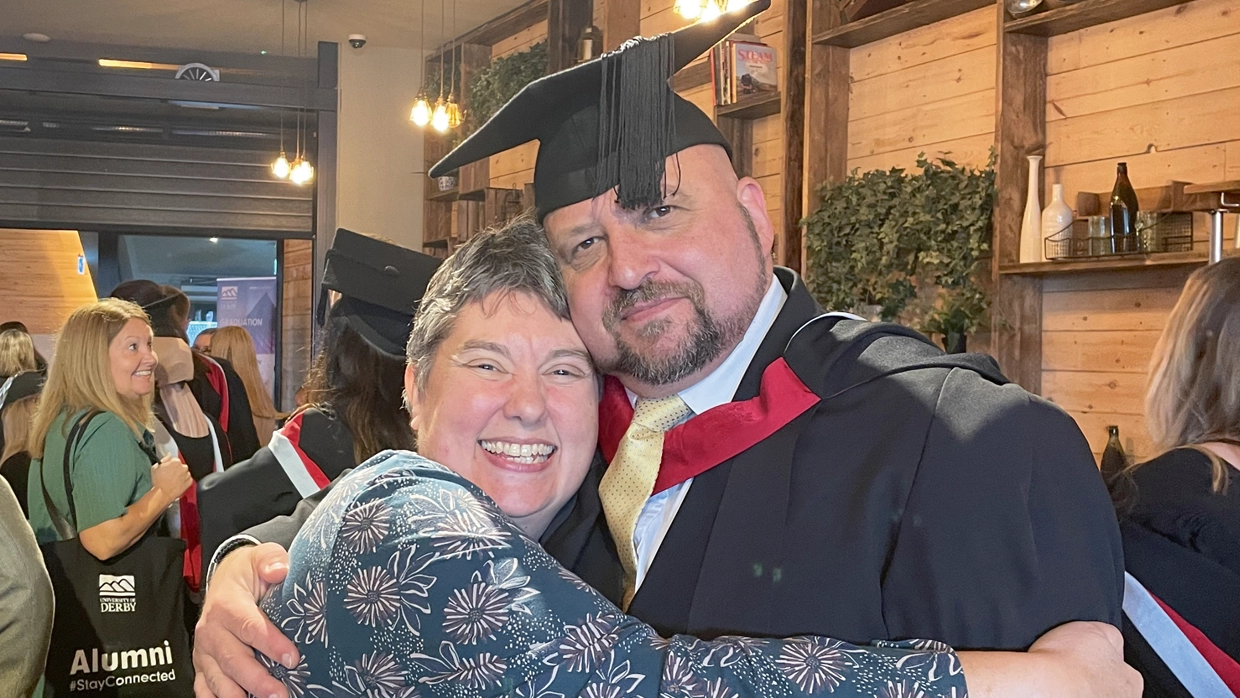
Motability Scheme customers Matthew LeDoux-Deakin (54) and Daisy Halford (34) decided to go to university after life-altering health diagnoses led them to re-evaluate their paths. Matthew decided to up-skill after he had a series of strokes and was diagnosed with Crohn's and Lupus. For Daisy, she was interested in pivoting her career after living with complex neurological disorders for many years. Here, they share their experiences as mature students.
Campus or distance learning?
Matthew chose the University of Derby specifically for the business management course but also wanted in-person connection. He had previously worked in project management and wanted to add theoretical knowledge to his practical skills.
He was also keen to show he could do it. "I was told that I would never walk or talk again but, when somebody tells me I can't do something, I decide that I want to prove them wrong."
Matthew selected a university that was a manageable 20-minute drive away from his home at the time. He advises potential students to test the waters thoroughly and go to open days before committing. "Go in and talk to both the academic and disability staff and see whether they will be able to meet your needs," says Matthew.
He went to the university to get his bearings before the term started, locating the lifts, the accessible toilets, and the quickest routes between lecture halls so that on day one he could focus on learning rather than logistics.
Daisy began a law degree, motivated to help others and demonstrate to her son that success is possible despite chronic illness. "I want to be able to show him that regardless of difficulties with my health... you can still achieve something," she says.
The physical demands of navigating a bricks-and-mortar campus were simply too high for Daisy. She opted for the Open University, which allows her to study entirely from home. "It's flexible. I can work around my health issues, my family..." she explains.
Daisy began with a single business and law module and recommends doing that for those who are nervous: "If you're not sure about doing a whole degree, start with just a module, like I did."
Finding support
A common fear among students with disabilities is that they will be left to fend for themselves. A recent government report, Disabled People's Lived Experience of Education, highlighted that students with disabilities face several barriers, including poor staff knowledge, limited training opportunities and inaccessible assessment. However, both Matthew and Daisy say they have had good experiences from their universities.
"I thought my disability would set me back. But the support has been overwhelming and fantastic," says Daisy. Speak to the disability services team and student support team, she suggests.
Daisy was able to access the Disabled Students' Allowance to cover extra study-related costs. She admits she was initially "worried" about the assessment but her experience was entirely positive. "The assessor was lovely," notes Daisy.
The assessment led to her being offered an ergonomic chair that moulds to her body, a specialised mouse and keyboard, a footrest and a high-quality monitor, which helps with migraines.
At the University of Derby, the disability team helped Matthew access funds "gifted and bequeathed" by past benefactors. One such grant paid for software that changed the colours of documents to prevent his migraines.
The university agreed to automatic extensions if his health flared up, provided a dedicated quiet room and arranged preferential parking right by the front doors.

Navigating the age gap
One of the most daunting aspects of going to university as a mature student is the age difference. Matthew admits he faced scepticism from other people about his decision. However, the reality was a heartwarming surprise. He found himself becoming a "surrogate university dad" to his younger peers. "A couple of them said it was like having a bonus tutor on the course," says Matthew.
The Disabled People's Lived Experience of Education report shows that students who have friends at university acknowledge they are vital to their experience of education and a source of valued, informal support.
Indeed, while Matthew offered his younger peers life experience and real-world context to the business theories being learned, the younger students also helped him. "I have tinnitus, so when people are murmuring I can't hear anything. The students I got close with were good at policing the class so I could hear."
Daisy also found it possible to network despite being online. "There are forums that are really good and, depending on what you are studying, there are web events you can attend," she says.
Just do it
If you are sitting on the fence about returning to education, Matthew and Daisy are proof it is possible. "Don't be afraid of your disabilities because they are your abilities," says Daisy. She believes acknowledging your challenges is the first step to overcoming them.
Matthew urges people to take the leap, regardless of what they may have been told in the past: "You don't know if you don't try."
USEFUL RESOURCES
★The Disabled Students Helpline provides advice to disabled students, apprentices and trainees in England. Email students@disabilityrightsuk.org or telephone: 0330 995 0414
★AbilityNet provides guides to adapt your phone, tablet or computer to meet your needs
★You can compare courses at the Discover Uni website
Photos: Courtesy of Daisy Halford and Matthew LeDoux-Deakin